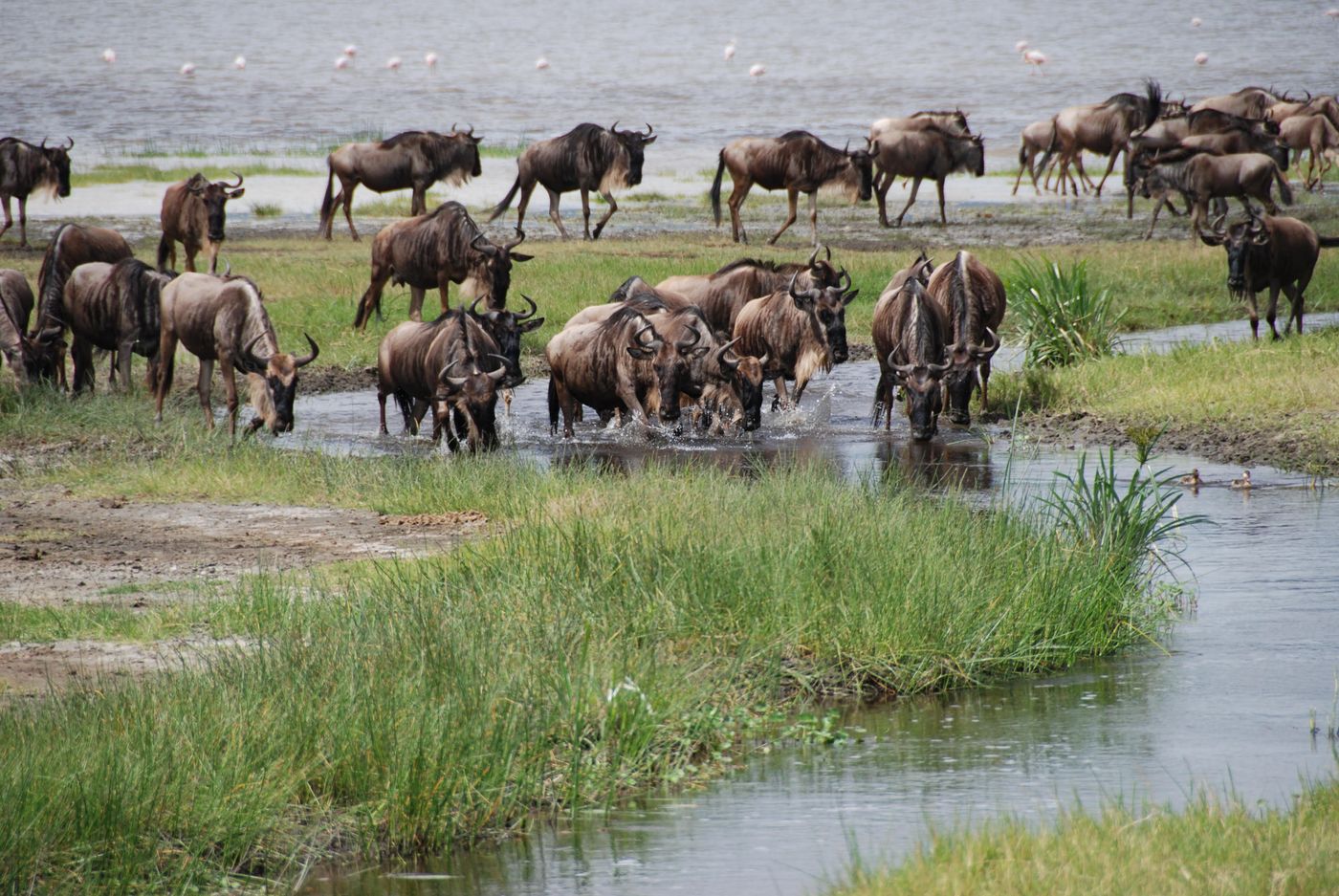
The Maasai Mara-Loita ecosystem in southern Kenya is the spatial backbone of what international tourism markets call the Great Migration. Wildebeest, zebra and gazelle move annually between the Serengeti in Tanzania and the Mara in Kenya, crossing the Mara River in scenes that have anchored Kenyan wildlife tourism for half a century. On present evidence, the ecosystem connectivity that makes the migration possible has collapsed by approximately 90 percent over the past fifteen years.1
Land conversion to agriculture, fencing of private conservancies and group ranches, infrastructure development and climate-driven changes to rainfall patterns have, between them, closed most of the historical movement corridors. The migration still happens. The migration that international tour operators sell — predictable, photographable, bookable — is increasingly an artefact of a system that no longer functions at the scale the marketing presumes.
What the marketing still says
Approximately 60 percent of Kenyan international tourism marketing centres on the Great Migration product, directly or by association. Kenya Tourism Board campaigns, tour operator brochures, hotel positioning and airline route marketing are all built around the proposition that the visitor will see the migration. The visitor still does see wildlife. What the visitor sees is no longer reliably the migration as marketed.
Kenya is selling a product the climate is rewriting in real time. The choice is between updating the product, updating the marketing, or absorbing the difference between the two as a structural credibility cost.
What ICPAC is now warning
The IGAD Climate Prediction and Applications Centre issued an active flood warning across the Mara catchment in March 2026.2 Successive seasons of intense, compressed rainfall have replaced the historical pattern of two distinct rainy seasons separated by predictable dry months. The implications for tourism are immediate. River crossings — the visual climax of the migration product — become unsafe or unphotographable when rivers are in full flood. Camp infrastructure on flood-prone sites is being damaged at higher frequency than the depreciation schedule was built to absorb. Insurance premiums are rising faster than nightly rates.
What the operators know
Senior conservancy managers and luxury safari operators have been adapting privately for at least five years: shifting departure windows earlier or later than the historical migration peaks, expanding product offerings around predator-density rather than herd movement, and beginning to position alternative geographies — Laikipia, the northern frontier, and trans-border products with Tanzania — as part of the Kenya wildlife proposition. Public-facing marketing has not yet caught up. The disjuncture is consequential. International travellers who book the marketed product and receive the operationally-adapted product return with diminished satisfaction. Repeat-visit rates fall. Word-of-mouth deteriorates.
Three architectural responses
First, an honest repositioning of the Kenya wildlife product around year-round predator and ecosystem density rather than the seasonal migration spectacle. This requires the tourism ministry, KTB and the operator community to coordinate a marketing pivot that acknowledges what is happening on the ground. The window for doing this proactively rather than reactively is narrowing.
Second, accelerated investment in conservancy infrastructure that is climate-resilient — elevated camps, redundant water systems, all-weather access tracks — paid for through a tourism climate-adaptation levy on the visitor bed-night, structured so that the levy is visible to the conscious-capital traveller as a contribution to landscape resilience. The conscious-capital segment will pay this; the mass segment will not, but the mass segment is not the segment Kenya should be optimising for in any case.
Third, a regional EAC framework with Tanzania to formalise the trans-border ecosystem as a single tourism product, allowing operators on both sides to sell a Mara-Serengeti experience that is decoupled from the seasonal migration crossings while protecting the underlying ecology. This requires diplomatic patience that has historically been in short supply. It is also the only structural response that addresses the root problem rather than the marketing problem.
The product Kenya sells internationally is no longer reliably the product Kenya has on the ground. Acknowledging that gap and rebuilding the product around what is actually still there is more strategically defensible than continuing to sell what was, while the climate continues to rewrite what is.